Introduction
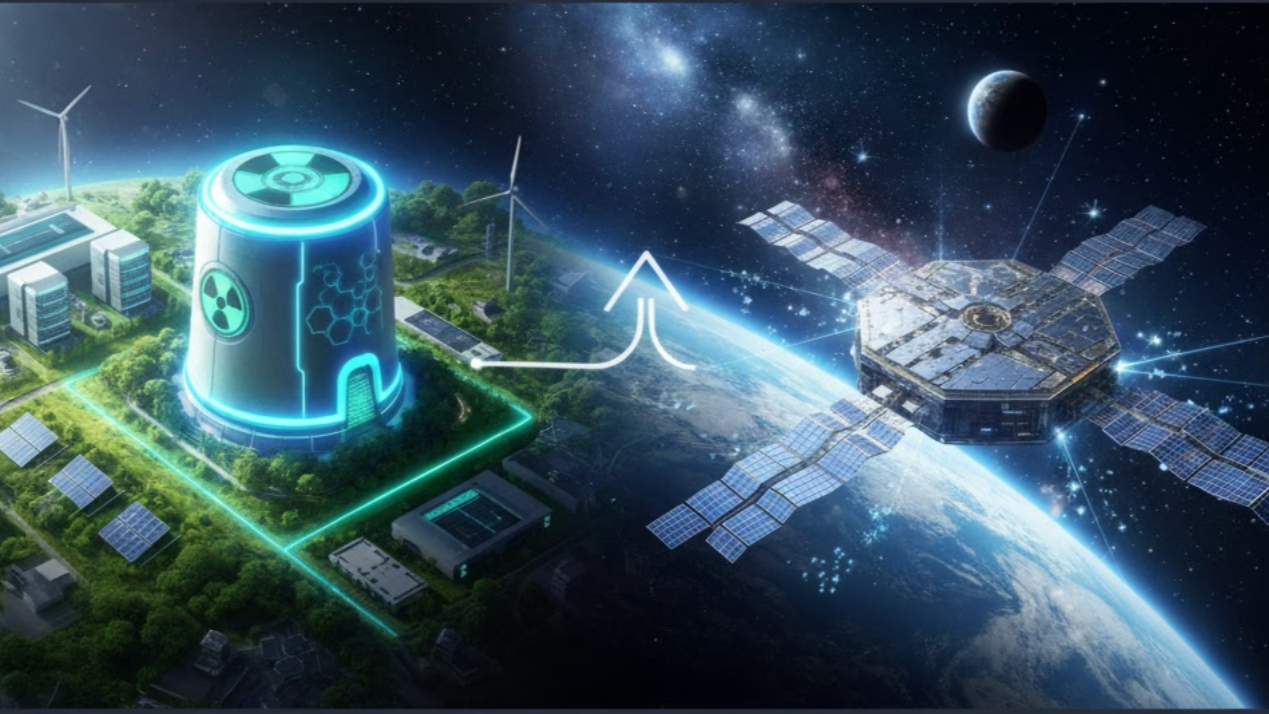
In my previous article, I discussed the Gigawatt Paradox—the seemingly insurmountable challenge of balancing the exponential power demands of AI with our urgent need for sustainable IT infrastructure. The energy deficit is real, and it’s forcing the industry to look beyond incremental improvements. We are now witnessing the emergence of truly radical, disparate innovations that promise to fundamentally redefine our environmental footprint: the rise of Small Modular Reactors (SMRs) and, perhaps most audaciously, the proposed deployment of datacentres in space.
As an AWS Ambassador, I believe its time we analyse how these ground-breaking solutions can scale to meet the AI tsunami and, crucially, how they stand to reshape the environmental landscape of the cloud for good.
Scaling the Power Source: Small Modular Reactors (SMRs)
On Earth, the most significant barrier to green computing remains reliable, 24/7 zero-carbon power. This is where SMRs emerge as a genuine game-changer.
Traditional nuclear power has always offered superb baseload capacity, but its scalability has been hampered by colossal upfront costs, lengthy build times, and the sheer physical size of the plants.
SMRs, by contrast, are factory-fabricated and transportable, offering a true path to industrial-scale, rapid deployment. A single SMR unit, with its small footprint, could provide zero-carbon baseload power to a hyper-scale datacentre campus, or a cluster of them could power an entire digital region.
This modularity allows power capacity to scale in lockstep with compute demand—a concept previously unheard of in the energy sector. This ability to co-locate highly efficient, clean power generation directly at the point of consumption is the single most powerful shift in the environmental power mix since the advent of large-scale renewables. It provides the density, reliability, and carbon-free operation necessary to solve the terrestrial Gigawatt Paradox.
While SMRs offer a powerful tool for decarbonising our energy supply and supporting AIs growth, the issue of nuclear waste cannot be overlooked. Through a combination of deep geological disposal, reprocessing, advanced reactor designs, standardisation, and robust regulatory oversight, we can significantly mitigate the negative environmental impact of this waste. The ongoing research and development in these areas are critical to ensuring that SMRs are not just a low-carbon energy source, but also a truly sustainable one.
Scaling Compute: Datacentres in the Final Frontier
If SMRs solve the problem of power supply on Earth, the notion of putting datacentres in orbit—as reportedly planned by Google—is an ingenious, albeit complex, solution to the problem of power consumption and heat dissipation.Heat management is the Achilles heel of hyper-scale computing, requiring vast amounts of land and water for cooling towers.
By positioning datacentres in the vacuum of space, operators gain access to a near-perfect heat sink. This eliminates terrestrial cooling costs and infrastructure, allowing compute density to scale dramatically without local thermal limitations.
Furthermore, in orbit, the datacentre could be powered by highly efficient solar arrays receiving uninterrupted sunlight, solving the intermittency issues faced by Earth-based solar farms. The ability to offload the massive thermal and water footprint of AI training and inference to a truly boundless environment is the ultimate scaling mechanism for compute.
Reshaping the Environmental Landscape
These two disparate innovations—one focused on clean energy generation and the other on thermal dissipation—represent a profound shift in our environmental strategy.
On the ground, SMRs tackle the primary sustainability challenge: decarbonisation of the energy source. They provide the high-capacity, non-intermittent clean power required to eliminate reliance on fossil fuels that currently back up renewable energy grids. The environmental net gain is direct and significant: a massive reduction in operational carbon emissions.
In space, orbital datacentres address the secondary, but equally critical, challenges: terrestrial resource strain. By removing a significant portion of AIs compute from the planet, we mitigate the demands on freshwater resources for cooling, reduce e-waste and infrastructure burden on landfill sites, and free up vast tracts of land currently slated for development.
The trade-off, however, introduces new environmental challenges: the emissions from rocket launches and the critical issue of orbital debris. We must ensure that a commitment to terrestrial sustainability doesn’t create an unsustainable cloud of space junk.
Ultimately, these innovations change the narrative from reducing impact to relocating impact. SMRs allow us to responsibly meet demand on Earth, while space-based compute offers an escape hatch for exponential growth. The future of sustainable IT will not be a singular solution; it will be a hybrid, dual-ecosystem approach, leveraging nuclear fissions reliable power at home and the vacuums cooling potential in the heavens.
The challenge now is not if we can meet demand, but how quickly we can operationalise these technologies with the highest safety and ethical standards. The gigawatt race is on, and the finish line is a net-zero future.