Introduction
In the fast-moving UK tech landscape of 2026, the narrative often feels like a zero-sum game. If you listen to the loudest voices on your LinkedIn feed, you’d be forgiven for thinking that traditional software engineering is dead, that Big Data is a relic of the 2010s, and that Artificial Intelligence is the only line item that matters in your annual budget.
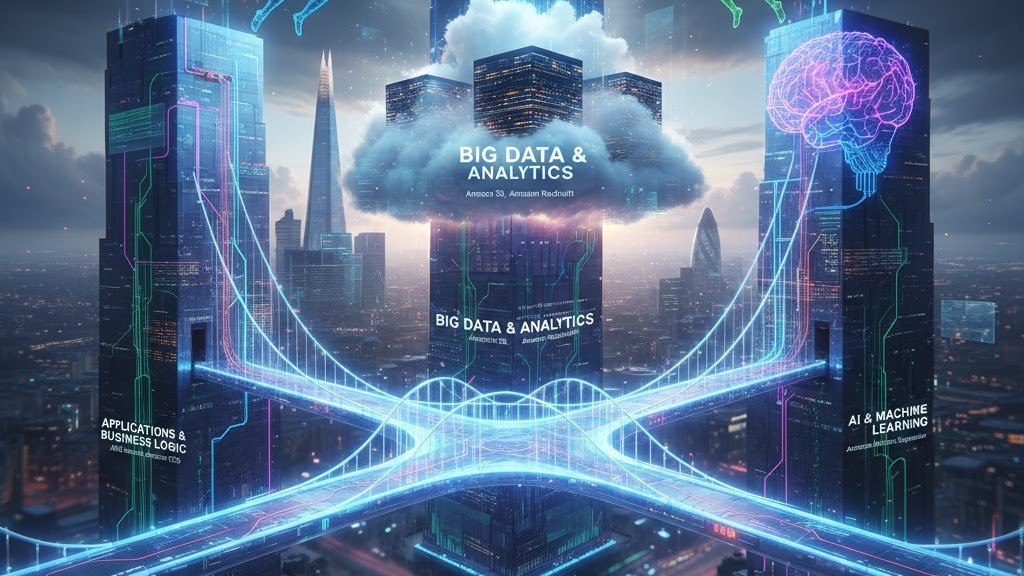
But here is the reality from the architectural trenches: AI is not a replacement for applications or data; it is the ultimate integration layer.
For CTOs, developers, and product owners across Britain, understanding the nuance between these pillars is the difference between building a scalable enterprise and throwing money into a “Black Box” of expensive API calls. We are moving away from isolated silos toward what we now call Intelligent Applications—powered by the rise of Agentic Workflows.
The Trinity of Modern Computing: A Definition
To understand where we are going, we must be precise about the three traditional pillars of tech. They represent fundamentally different ways of solving a problem.
Applications & Business Logic (The Process)
This is the “classic” world of software. It is deterministic. When you use your banking app to transfer £50, you don’t want the computer to “predict” where the money should go based on your mood. You want it to follow a strict set of rules.
- The Logic. “If [Condition A], then [Action B].”
- The Goal. Reliable, repeatable execution.
Big Data & Analytics (The Memory)
This is the “historical” layer. It’s about taking the vast exhaust of your business—every click, every sale, every sensor reading—and turning it into a narrative.
- The Logic. Descriptive and Diagnostic. It tells you what happened and why.
- The Goal. Transparency and decision-making support for humans.
AI & Machine Learning (The Intuition)
This is the “probabilistic” layer. It doesn’t “know” the answer in the way a database does; it “infers” the answer based on patterns.
- The Logic. Predictive and Generative. “Based on everything I’ve seen, there is an 89% probability the user wants X.”
- The Goal. Scalable pattern recognition and autonomous insight.
The 2026 Game Changer: Agentic Workflows
While the three pillars above describe what the systems are, Agentic Workflows describe how they now act.
In 2024, AI was mostly “Zero-Shot”—you gave a prompt, and it answered. In 2026, we have moved to Agents. An Agentic Workflow is an iterative process where an AI doesn’t just answer a question; it reasons, plans, and uses tools to achieve a goal.
Why Agents Change the “Replacement” Debate
The fear that AI replaces applications disappears when you see how Agents actually work. An Agent is essentially an AI with a “tool belt” of traditional applications.
- The Planning. The AI breaks a complex task (e.g., “Onboard this new supplier”) into sub-tasks.
- The Tool Use. The AI calls a traditional Application to verify a VAT number, queries a Big Data lake to check historical pricing, and then uses Business Logic to send a contract.
The shift isn’t a replacement; it’s a delegation. We are moving from “Software you operate” to “Software that operates on your behalf.”
Engineering the Future with AWS: A 2026 Blueprint
For those building in the cloud, this convergence is managed through the Amazon Web Services (AWS) ecosystem. AWS has spent years ensuring that logic, data, and AI work as a singular nervous system.
The Logic Layer (Apps)
- AWS Lambda & Step Functions. The “connective tissue.” Step Functions are now the primary way to orchestrate Agentic Workflows, managing the state and the “if/then” guardrails around an AI’s decisions.
The Data Layer (Analytics)
- Amazon S3 & Redshift. Your AI is only as smart as its memory. These services provide the “Knowledge Bases” that Agents query via RAG (Retrieval-Augmented Generation) to ensure they aren’t hallucinating.
The Intelligence Layer (The Agents)
- Amazon Bedrock Agents. This is the flagship for 2026. It allows you to build agents that automatically understand user intent, break down tasks, and—crucially—call your other AWS services as “Action Groups.”
- Amazon SageMaker. When you need a highly specialised “brain” (e.g., a custom fraud model or medical diagnostic tool) rather than a general-purpose LLM.
Why your “Legacy” Logic is your Greatest Asset
There is a common mistake: “Let’s scrap our old systems and just use an AI Agent.” This is a recipe for disaster.
In a professional UK context—especially in regulated sectors like Finance or Law—unfiltered AI is a liability. Your “Legacy” Business Logic acts as the Guardrails.
- Safety: You use hard-coded logic (AWS Lambda) to ensure an Agent never spends more than £500 without human approval.
- Compliance: You use traditional Databases to maintain an immutable audit trail of what the Agent did.
- Accuracy: You use Big Data to provide the “Ground Truth” so the AI doesn’t make up facts.
Summary: The Path Forward for Leaders
So, is the latter replacing the former? Categorically, no. We are entering the era of the Composite System. The most successful tech products of the next five years won’t be “AI companies”—they will be companies that have mastered the art of Agentic Orchestration.
- Stop looking for “The AI Version” of your software.
- Start looking for how Agents can call your software.
- Invest in your Data Pipeline. Your AI agents are only as good as the “Knowledge Base” you give them.
The “Business Logic” of your company—the unique way you handle customers or manage stock—is your “Moat.” AI is simply the new, high-speed engine you’re putting under the bonnet of that existing car.
The future isn’t about choosing between apps, data, or AI. It’s about building the Agentic bridge between them.