The technological narrative of the decade is dominated by Artificial Intelligence (AI). From generative models transforming content creation to sophisticated algorithms optimising global logistics, AI’s capabilities are revolutionary. Yet, this revolution is unfolding against a stark and pressing backdrop: a global IT sustainability crisis.
Microsoft CEO Satya Nadella recently crystallised this challenge, revealing that the company has a massive inventory of power-hungry AI GPUs it simply cannot plug in due to a lack of available electrical power and ready data centre infrastructure. This is the Gigawatt Paradox: AI is simultaneously the most powerful tool for solving global efficiency problems, and the single greatest threat to data centre sustainability.
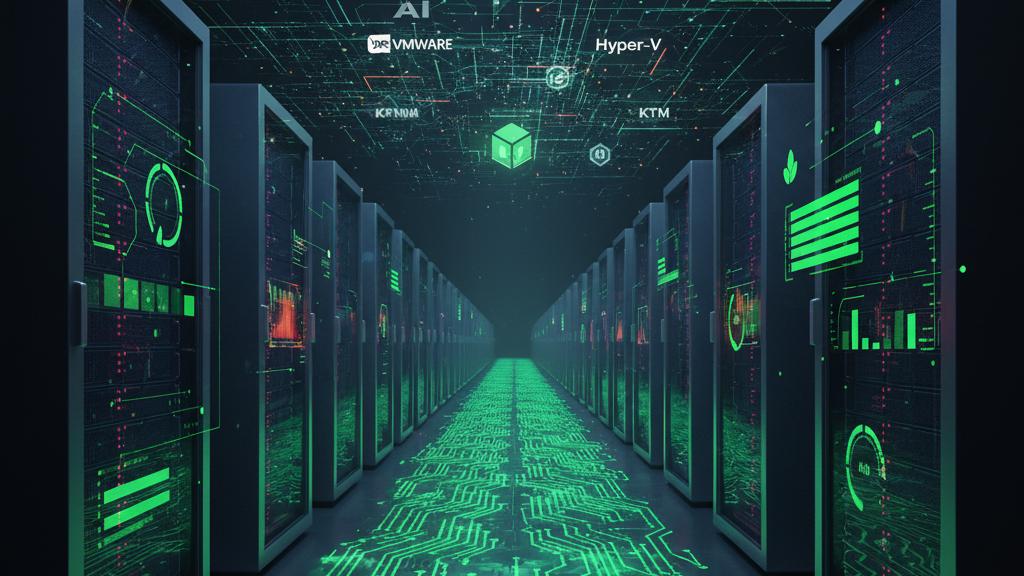
The battleground for this paradox is the foundation of modern IT infrastructure: the hypervisor. This critical layer, which manages and abstracts physical compute resources, must now evolve from a simple virtualisation tool into an intelligent, AI-managed orchestrator of sustainable IT operations. The shift is already underway, impacting all major hypervisor platforms—from proprietary giants like VMware/Broadcom and Microsoft Hyper-V to open-source solutions like KVM and Xen.
The AI Consumption Crisis: A Demand Outpacing Supply
To grasp the necessary changes, one must first appreciate the scale of AI’s resource consumption. Training a single large language model (LLM) can consume the equivalent energy of a small city for days or weeks. Furthermore, the operational phase—known as inference—is a continuous, massive drain.
This consumption is unique because it’s not just about energy (kilowatt-hours); it involves three critical sustainability vectors:
- Power Draw (Energy/Carbon Footprint). The relentless demand for high-performance GPUs (e.g., NVIDIA H100s) drives up server power density, requiring exponentially more electricity. This directly translates to increased reliance on the power grid and a larger carbon footprint.
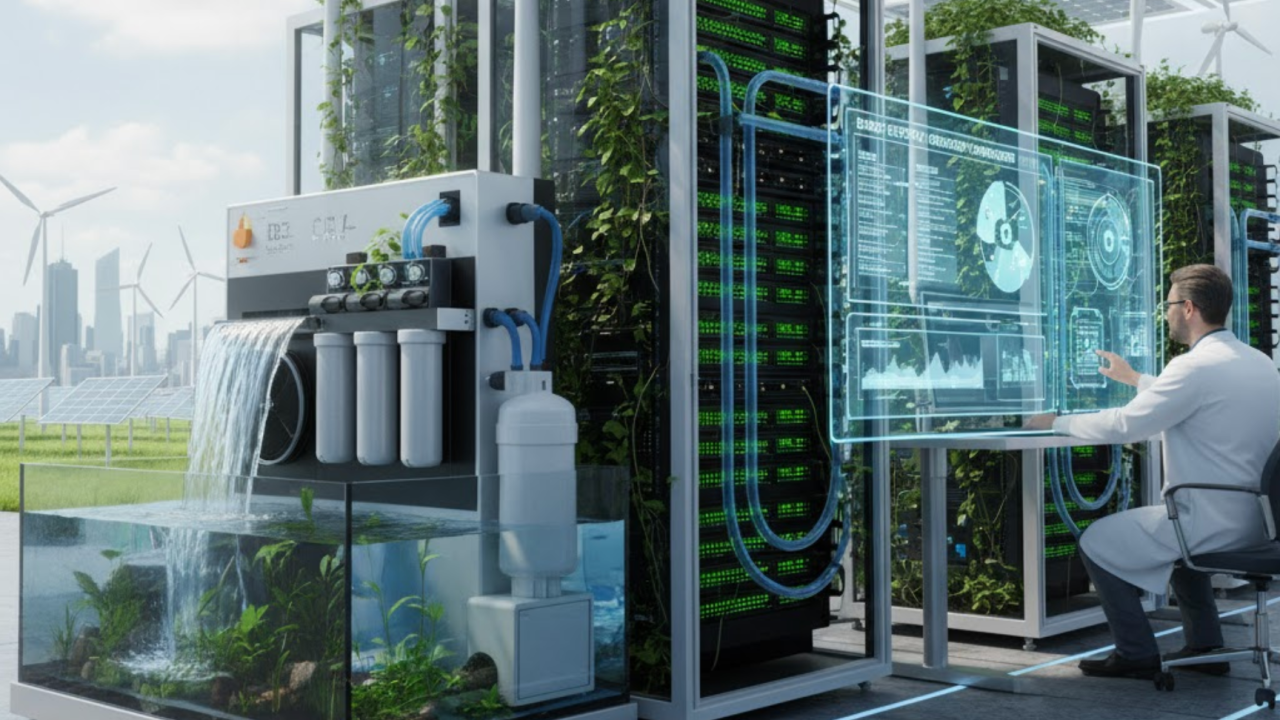
- Thermal Management (Water/Cooling). Increased power density means more heat. Data centres must deploy more aggressive cooling solutions, often relying on massive volumes of water for evaporative cooling or high-powered chiller plants. The environmental impact is shifting from energy alone to water scarcity and heat rejection.
- Hardware Churn (E-Waste). The rapid innovation cycle of AI silicon means that last year’s GPU accelerators quickly become sub-optimal. This short lifespan accelerates e-waste, creating a sustainability problem that software optimisation alone cannot solve.
The hypervisor, in its traditional role, simply facilitates the running of these resource-hungry workloads. It must now be augmented with AI-driven intelligence to mitigate the damage its guests—the AI applications—are causing.
AI as the Architect of Efficiency: The Tool-Kit for Green IT
The solution to the Gigawatt Paradox lies in weaponising AI against its own wasteful tendencies. By integrating machine learning models directly into the virtualisation management plane, IT organisations can achieve levels of resource optimisation that were impossible with traditional, rule-based automation. This is the shift from automation to Intelligent Resource Management (IRM).
Intelligent Workload Scheduling & Migration
The most immediate opportunity for sustainability is optimising where workloads physically run. AI introduces predictive, environmental awareness:
- Prediction and Placement. An IRM system can analyse historical usage patterns and predict future compute needs. It can then place VMs not just based on availability, but on energy efficiency. A low-priority LLM inference job might be automatically migrated to a server farm running on renewable energy or a rack in a colder location that requires less cooling.
- Density Optimisation. AI can safely increase VM density on a single physical host by predicting resource contention with much higher accuracy. By consolidating workloads, the number of “idling” physical servers—which still consume significant power—can be drastically reduced.
Dynamic Right-Sizing & Allocation
Over-provisioning is one of the greatest silent killers of IT efficiency. IT teams habitually assign more resources than a VM requires “just in case.”
- AI for Resource Tapering. Machine learning models can continuously monitor the actual resource consumption of AI/ML workloads. The AI can dynamically shrink the allocated resources of a VM—a process known as right-sizing—and instruct the hypervisor to reclaim the excess physical resources. This ensures that only the compute required at that moment is available, immediately lowering the power envelope.
Hypervisor Ecosystems & AI Integration
The implementation of these IRM strategies varies based on the hypervisor ecosystem, but the core principle—AI-driven resource governance—remains constant.
Microsoft Hyper-V & Azure Stack HCI
Microsoft’s strategy heavily leverages its cloud AI capabilities. For on-premises Hyper-V deployments (especially those running on Azure Stack HCI), the integration is focused on connecting the local virtualisation layer to the extensive monitoring and machine learning services available in Azure. Tools like Azure Arc allow the local Hyper-V management plane to feed real-time telemetric data into cloud-based AI models, which then deliver efficiency policies back down to the local data centre.
VMware (vSphere / Broadcom)
As a dominant player, VMware’s approach is integrated and highly proprietary. AI-driven sustainability is embedded within its management suite (historically vRealize, now VMware Aria Operations). The focus is on closed-loop automation, where the AI model generates a recommendation and the vSphere hypervisor executes it instantly without human intervention. This tight integration allows for very fine-grained control over individual hosts and power management policies for clusters based on predetermined carbon efficiency goals.
KVM & Open-Source Virtualisation
In open-source environments like KVM (Kernel-based Virtual Machine), innovation is often community-driven and integrated via orchestration layers like OpenStack and Kubernetes. Here, AI sustainability tools often manifest as specialised scheduling plug-ins or ML-backed control plane modules. An AI scheduler can use machine learning to calculate the carbon intensity of power grids connected to different clusters before deciding where to deploy a new virtualised container.
Amazon Web Services (AWS) & Nitro
AWS has made perhaps the most architectural leap specifically to address the efficiency demands of modern, high-intensity workloads like AI. AWS’s foundation for modern EC2 instances is the AWS Nitro System.
- Architectural Shift: AWS engineered Nitro to move many traditional hypervisor tasks (such as networking, storage, and security) onto dedicated, purpose-built hardware (Nitro Cards).
- Sustainability Gain: By offloading these resource-intensive processes, the lightweight, custom KVM-derived hypervisor on the host requires less power overhead itself. This architectural focus means that every unit of power consumed by the physical host is more directly translated into useful compute for AI and other applications, inherently improving the Compute Per Carbon (CpC) metric. AWS is already making significant gains by ensuring their architecture delivers near bare-metal performance while consuming less residual host power.
Beyond the Virtualisation Layer: A Mandate for New Metrics
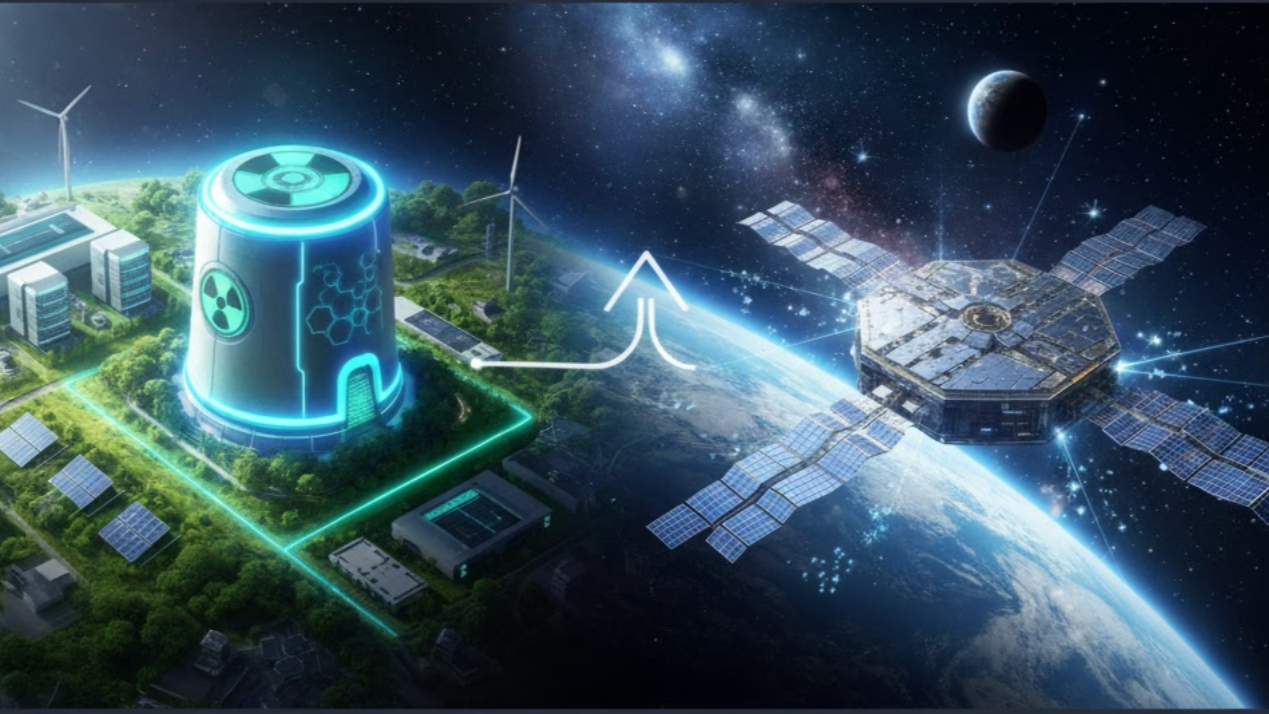
While AI optimising the hypervisor layer is crucial, the exponential growth of AI compute demands a fundamental change in the energy supply itself. This is why the industry is now seriously considering, and investing in, solutions like Small Modular Reactors (SMRs) and dedicated large-scale renewable energy farms.
Furthermore, the IT industry must move beyond Power Usage Effectiveness (PUE), which only measures data centre infrastructure efficiency. We need new metrics that capture the full, end-to-end sustainability impact:
- Carbon-Adjusted PUE (C-PUE): PUE weighted by the real-time carbon intensity of the local power grid.
- Water Usage Effectiveness (WUE): The amount of water consumed per unit of energy, a critical factor in arid regions.
- Compute Per Carbon (CpC): The amount of useful computation delivered per kilogram of CO2 emitted.
The integration of AI into the hypervisor layer is the mechanism that allows IT teams to act upon these advanced metrics. AI-managed Green IT will not just be about “running things faster,” but about “running things smarter, cheaper, and cleaner.”
Conclusion: A Call to Action for Infrastructure Architects
The Gigawatt Paradox presents a clear mandate for thought leaders and infrastructure architects: we cannot afford to deploy AI for optimisation without first optimising the infrastructure that runs the AI. The hypervisor layer, the very fabric of the data centre, is the pivotal point for this transformation.
The transition from basic virtualisation to an Intelligent Resource Management framework across VMware, Hyper-V, KVM, and all other platforms, is no longer a luxury—it is an existential necessity for scaling AI responsibly. By investing in AI models to manage silicon, power, and thermal resources, we can harness the revolutionary power of AI while steering clear of an environmental and infrastructural collapse. The future of AI is not just about compute power; it is about sustainable compute power. And that future is being built, one optimised virtual machine at a time, on a hypervisor layer that is finally turning green.